
Evidence-Grounded and Actionable Feedback
for Scientific Papers in Progress

An AI advisor that diagnoses your draft — pointing to where each issue is, why it matters, and how to fix it.
Kevin Qinghong Lin1, Siyuan Hu3, Pan Lu2, Yu Chen1, Yanzhe Chen3, Owen Queen2, Yupeng Chen1, Jialin Yu1
Junchi Yu1, Zifeng Ding5, Yuanfeng Ji2, Sheng Liu2, Jindong Gu1, Linjie Li4, Mike Zheng Shou3
Philip Torr1,✉, James Zou2,✉
1University of Oxford  ·  2Stanford University  ·  3National University of Singapore  ·  4University of Washington  ·  5University of Cambridge
✉ Corresponding authors
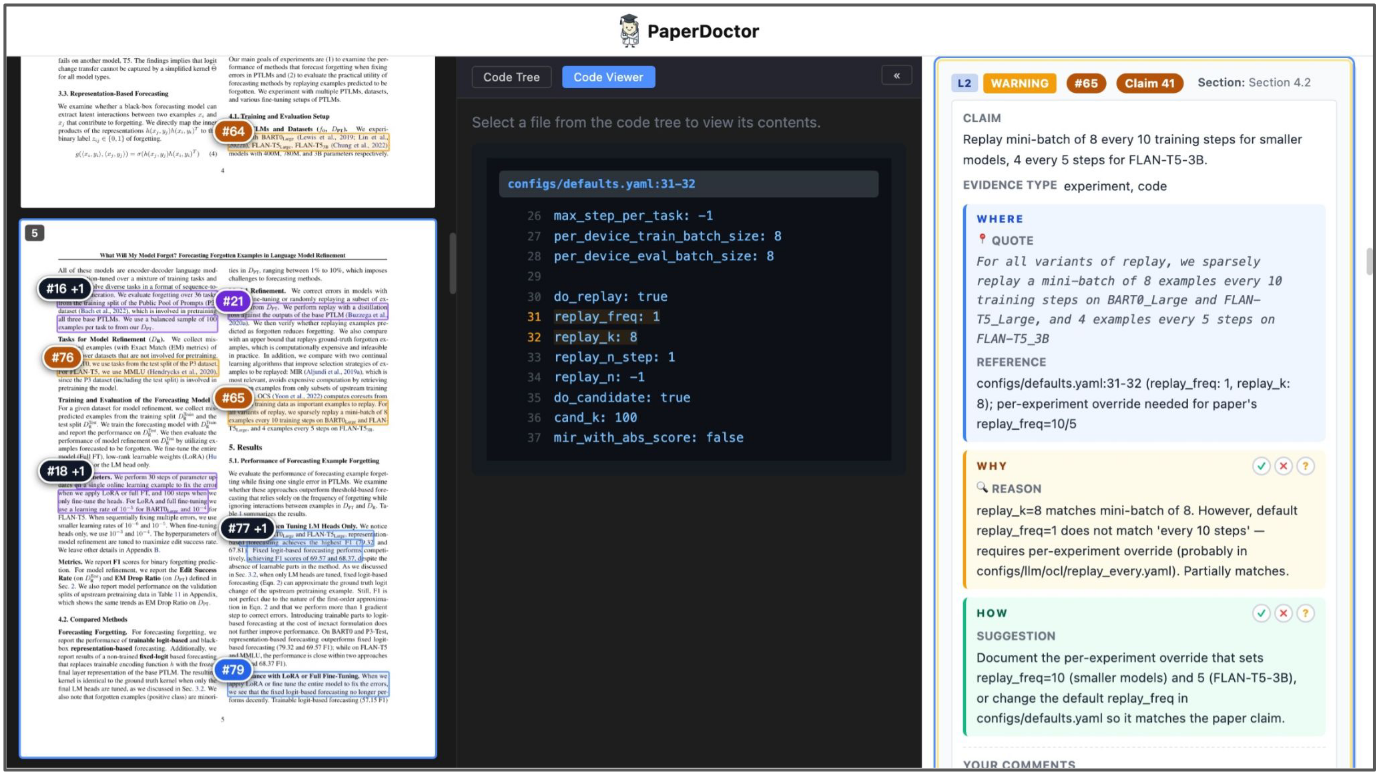
The PaperDoctor diagnosis interface
The PaperDoctor diagnosis interface. Authors upload their paper and code, and PaperDoctor returns a holistic report. Left: the paper, with each finding overlaid as a numbered, color-coded bubble anchored to the exact span it critiques (Where). Middle: a code viewer, so implementation findings can be audited against the source. Right: the finding card showing the observation (Why) and a concrete revision suggestion (How).

Abstract

Autoresearch agents are reshaping the research pipeline, but they also let flawed claims enter the literature at scale. Human advisors catch such issues on in-progress drafts through careful, traceable feedback — yet advisor-style assessment requires extensive manual effort and does not scale. To shift automated paper assessment from a judge to a diagnostician, we introduce PaperDoctor, an agent framework for pre-submission feedback. Every paper is evaluated across writing, layout, references, code, theory, prior work, and experiments through three layers: L1 surface screening runs on every submission; L2 typed verifiers route each claim to the skill that owns its evidence; and L3 reproducers rerun experiments by priority. Each finding is a triple — an observation (Why), a pointer to a specific location (Where), and a revision suggestion (How) — making every critique auditable and actionable. On a human study of junior researchers' pre-submission drafts, PaperDoctor reaches 85% agreement; across 60 manuscripts spanning ML, the natural and social sciences, it produces more grounded feedback than human and LLM reviewers, and its reproduction stage surfaces limitations invisible from the manuscript alone.

Every finding is a triple

Unlike a reviewer's verdict, each PaperDoctor finding is auditable and directly actionable.

Why

The observation

What is wrong and the reasoning behind it — flagged as an error when confidently incorrect, or a warning when it needs the author's judgment.

Where

The evidence

A pointer to the exact location: a sentence, an equation, a code line, or an external URL — so the critique can be traced without searching the paper.

How

The suggestion

A concrete revision the author can apply — not just a statement of what is wrong, but a recommendation for what to change.

Key Innovations

PaperDoctor reframes automated paper assessment as a diagnostic process rather than a verdict.

01

Holistic, hierarchical pipeline

A paper, its code, and its data are decomposed across seven dimensions and organized into three levels of increasing cost — spending effort proportional to the cost of verification.

02

Evidence-grounded, actionable feedback

Each finding pairs an observation (Why) with a concrete location (Where) and a revision suggestion (How), making every critique auditable and fixable.

03

Effective experimental reproduction

Beyond reading, PaperDoctor selectively rebuilds and reruns experiments by claim importance and compute budget — surfacing reproducibility gaps invisible from the manuscript alone.

A Three-Level Pipeline

Cheap screens run by default; typed verifiers are routed by evidence; full reproduction is gated on the author's approval.

L1 · Surface Screening

Read the manuscript

Low-cost, mostly objective checks that run directly on every submission. All four skills run in parallel.

  • Writing — typos, grammar, phrasing
  • Figure & layout — overflow, captions, contrast
  • Citations — does each reference resolve?
  • Claim extraction — atomic, typed claims
L2 · Claim Verification

Route each claim to its evidence

Every extracted claim is dispatched to the verifier that owns its evidence. Verifiers and per-claim dispatch run in parallel.

  • Code — claims vs. released source
  • Theory — re-derive proofs step by step
  • Literature — novelty & cited facts via web search
  • Experiment design — fairness, ablations, rigor
L3 · Reproduction

Rerun the experiments

The most expensive stage. A prioritized plan from L2 is executed only with the author's approval, spending compute where evidence is the constraint.

  • Build the environment
  • Run by priority & feasibility
  • Compare reproduced vs. reported numbers
  • Flag pass / warning / error on the gap

Results

PaperDoctor's feedback is more grounded than human and LLM reviewers, and tracks paper quality.

85%
author agreement in the human study
60
manuscripts across ML, natural & social sciences
100%
of findings grounded to a concrete locus
(vs. 25% human · 51% LLM)
7
assessment dimensions, from writing to reproduction

Human and LLM reviewers concentrate ~76–90% of their attention on the paper body, rarely opening the released code. PaperDoctor distributes attention differently — 18% of its findings check the surrounding literature and 12% verify the released code — and by executing that code it uncovers discrepancies between reported and actual results that reading-only review cannot detect.

BibTeX

If you find PaperDoctor useful, please consider citing:

@article{lin2026paperdoctor,
  title   = {PaperDoctor: Evidence-Grounded and Actionable Feedback
             for Scientific Papers in Progress},
  author  = {Lin, Kevin Qinghong and Hu, Siyuan and Lu, Pan and Chen, Yu and
             Chen, Yanzhe and Queen, Owen and Chen, Yupeng and Yu, Jialin and
             Yu, Junchi and Ding, Zifeng and Ji, Yuanfeng and Liu, Sheng and
             Gu, Jindong and Li, Linjie and Shou, Mike Zheng and
             Torr, Philip and Zou, James},
  journal = {arXiv preprint},
  year    = {2026}
}